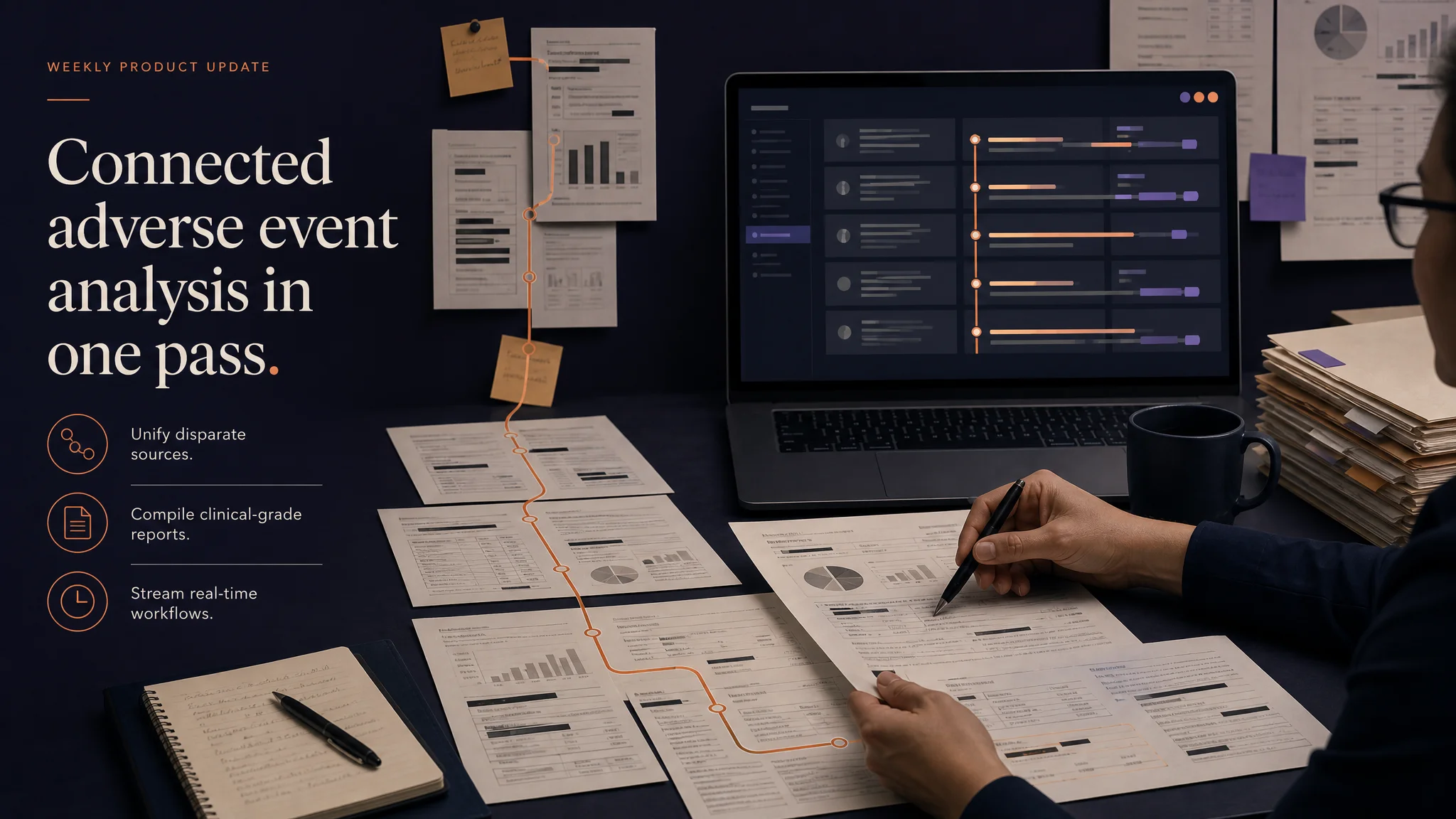
Coordinators told us the most time-consuming part of adverse event documentation is not the initial grading. It is the follow-up: attribution analysis, interaction review, and the report compile. This week we eliminated the multi-step burden by connecting the analysis into one pass.
Connected analysis in one pass, with reports the auditor can actually use
Coordinators have consistently told us the most time-consuming part of adverse event documentation is not the initial CTCAE grading. It is the follow-up: running attribution analysis to identify which drug in a combination regimen caused the event, checking for known interactions, and then compiling everything into a regulatory-quality report. The conventional flow is grade-pause-attribute-pause-interact-pause-report.
This week we eliminated those pauses. CTCAE grading, multi-drug attribution, and clinical evidence analysis now run as a single connected pipeline. The audit-ready report PDF is one click after the analysis completes. And each workflow step streams its progress as it runs, so clinicians can begin reviewing the earlier results while later steps are still processing.
Here is what shipped, why it matters, and what is next.
Feature Highlight 1: Connected clinical analysis in one pass
When CTCAE grading completes, the platform now automatically triggers two downstream workflows in parallel: multi-drug attribution analysis using WHO-UMC and Kramer causality algorithms, and clinical evidence analysis. The three results appear side by side in a unified tabbed interface with real-time progress indicators for each.
The architecture pattern is parent-child. The master CTCAE workflow serves as the foundation. On completion, it converts its output into typed inputs for the downstream workflows and triggers them automatically. Clinicians see results populate as each step completes, not when the entire pipeline finishes.
For a typical case with three to five adverse events on a combination regimen like FOLFOX or carboplatin/paclitaxel, the complete analysis from clinical note to graded events with attribution and evidence now runs end to end without manual intervention. AI suggests, clinicians decide.
Feature Highlight 2: Clinical-grade AE report PDFs
Documentation is a critical requirement in clinical trials. Auditors need clear, complete records of every adverse event, its grade, the attributed drugs, and the regulatory implications.
The platform now generates branded, audit-ready adverse event reports with:
- Patient context card with visit details and study site information
- Severity-colored AE cards with Grade 1-5 grade badges
- Drug attribution pills showing WHO-UMC and Kramer causality categories per drug
- Regulatory cascade section with automatic flagging for FDA MedWatch, IRB urgent protocol report, sponsor SAE notification, and AE log entries per ICH-GCP rules
- Summary statistics including grade distribution and confidence metrics
The report generation pulls from a parallel enrichment query that fetches visit, patient, protocol, study site, attribution workflow output, and workflow review data simultaneously. Reports reflect the complete clinical picture, including clinician overrides and review status.
Feature Highlight 3: Real-time workflow streaming
Previously, clinicians submitted a clinical note and waited for the entire AI pipeline to complete before seeing results. With this week's streaming upgrade, each workflow step reports progress independently.
The five-step pipeline (term extraction, drug standardization, batch CTCAE lookup, clinical judgment, output assembly) now emits step-by-step events. The frontend reconstructs these into a visualization with clear status indicators: completed steps collapse automatically, in-progress steps show streaming output, pending steps display waiting states.
The streaming reduces perceived wait time significantly. For complex cases, clinicians can start reviewing extracted terms and standardized drug names while the clinical judgment step is still processing. The pipeline uses content-hashed clinical notes for caching, so modified notes trigger fresh analyses while unchanged notes return cached results instantly.
Improvements
- Alpha environment: a new alpha environment for design partners and early testers to validate features before production rollout
- Centralized auth configuration: 27 trusted-origin URLs consolidated from three separate locations into a single shared configuration, reducing maintenance overhead
- Sign-in resilience: session persistence across page reloads, sign-in expiry increased from 10 to 15 minutes, inline errors instead of modal-close on failure
- Patient MRN handling: MRN field now saves correctly across all four patient creation workflows
- CTCAE term search: fixed parameter alignment between frontend and backend, ensuring search results render correctly
- Recording guards: patient assignment is now required before starting a recording session
Looking Ahead
Next: expanded clinical evidence analysis, improved report generation flow, and deeper SMART on FHIR integration patterns in the alpha environment.
Every grade is cited to source text and criteria. Zero hallucinations by design. AI suggests, clinicians decide.