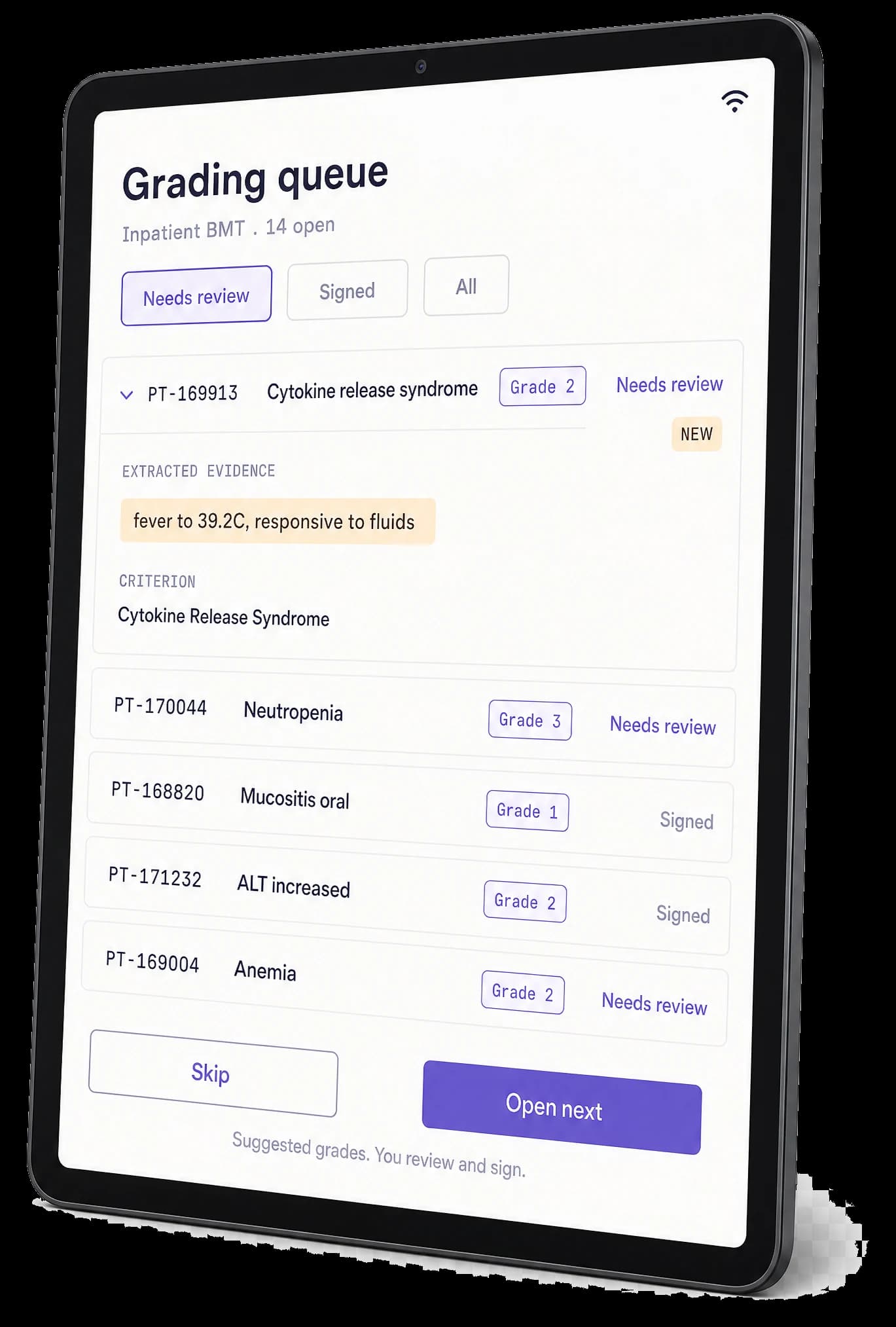
Monday morning. The coordinator opens her queue inside the EHR. Six adverse events landed over the weekend across four trials. Each one arrives with the source sentence highlighted, a suggested CTCAE grade, and the WHO-UMC or Kramer attribution path already worked out. She agrees on five and signs them in under fifteen minutes. She modifies one (the nausea is Grade 2, not Grade 1); her reasoning is logged with the edit, and the calibration improves quietly behind her work.
At ten she meets the new coordinator who started six weeks ago. They review three charts together. The new coordinator is grading her first cycles independently. Her inconsistency rate has been falling steadily since week one because the citation is on every suggestion and the reasoning is legible. The senior coordinator’s review takes five minutes per chart, not twenty. The bench is deeper than it was a quarter ago.
By noon the SAE that came in on Friday is ready for the PI. The attribution chain is drawn. The narrative is drafted with the named-algorithm reasoning. The PI reads it, makes one edit, signs. The packet ships to the sponsor before lunch. Last quarter this would have been a Thursday task.
At three the sponsor monitor for the Phase 1 trial logs in. She finds the source sentence on the grade she would have queried. She closes the review without opening a query. The coordinator never sees it. The audit trail is already built.
She leaves at five. The grading is done.