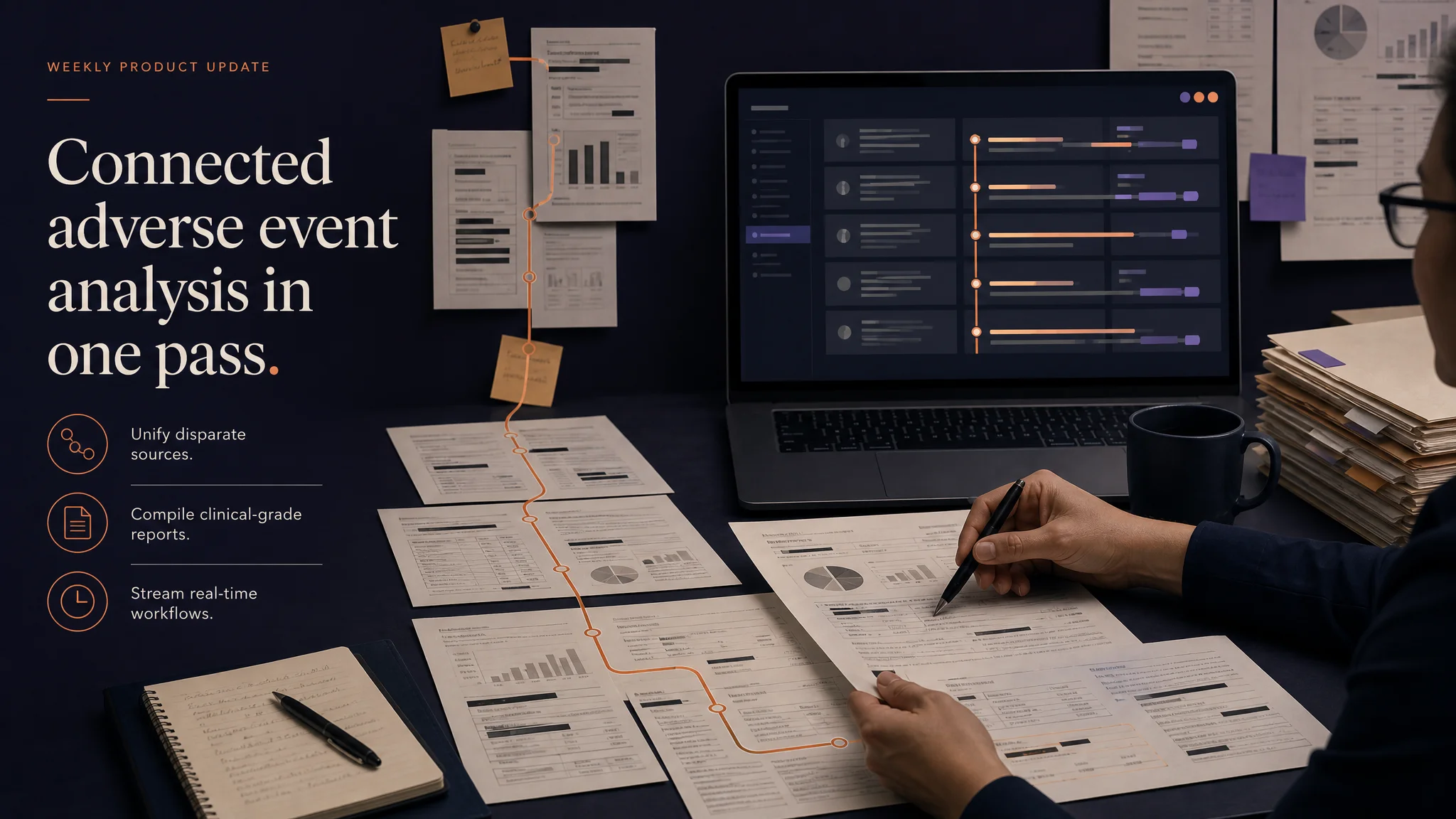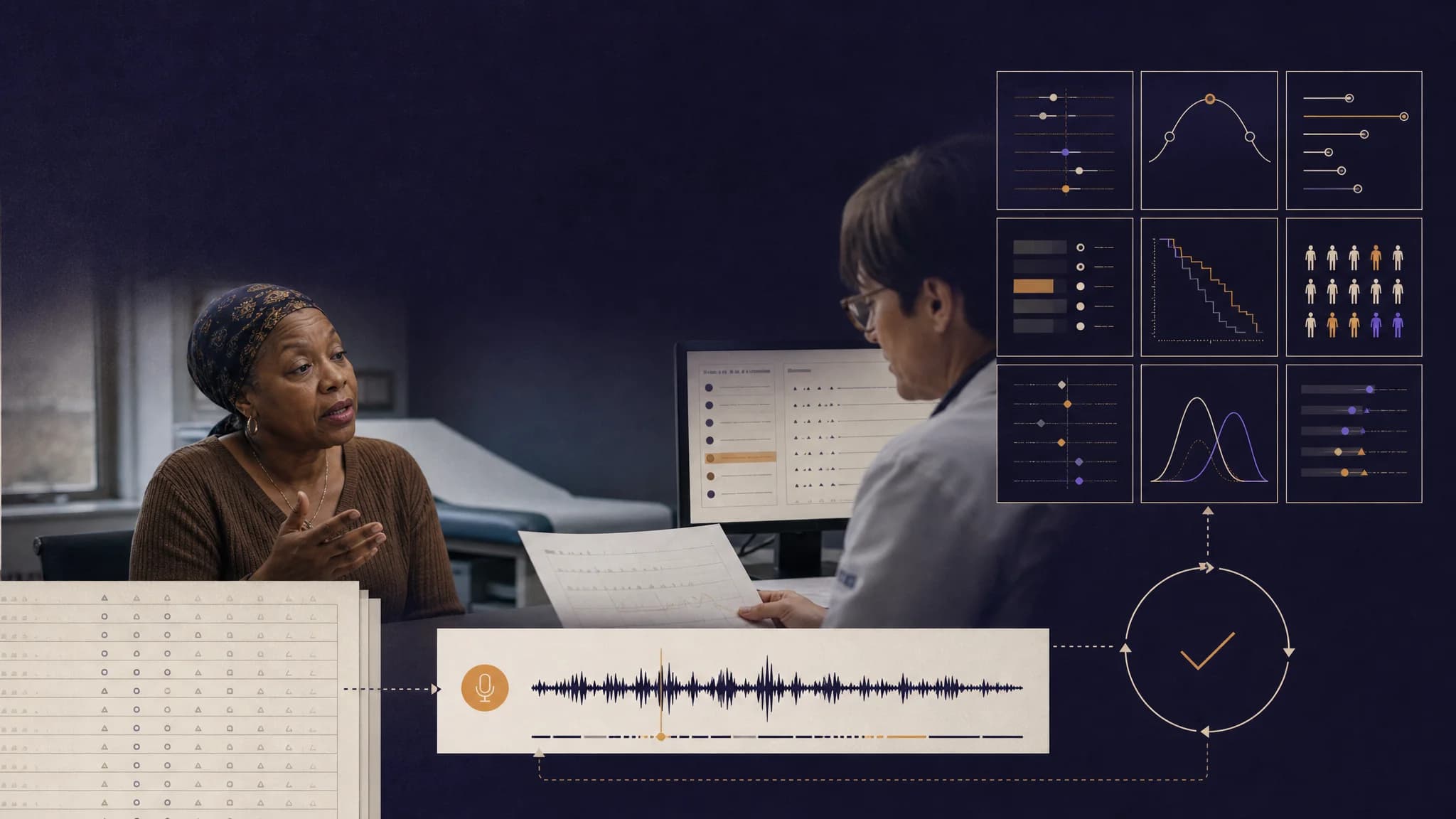
CTCAE grading accuracy depends on context. A peripheral neuropathy finding means something different in a patient with Type 2 Diabetes than in a patient without prior neurological history. This week we shipped four capabilities that bring the right clinical context into the grading workflow.
Bringing the right context into the grading workflow
CTCAE grading accuracy depends on context. A peripheral neuropathy finding means something different in a patient with Type 2 Diabetes than in a patient without prior neurological history. A Grade 2 nausea that has not changed across four consecutive visits might reflect genuine clinical stability, or it might be a documentation artifact that no one has revisited.
These are the kinds of clinical judgment calls that coordinators make dozens of times per day. They require pulling context from multiple sources: prior visit notes, medication lists, comorbidity histories, and institutional vocabulary about how terms map to criteria. This week we shipped four capabilities that bring that context directly into the grading workflow.
Here is what shipped, why it matters, and what is next.
Feature Highlight 1: Comorbidity-aware CTCAE grading
When the platform evaluates an adverse event, it now cross-references the patient's known comorbidities against the findings in the clinical note.
Consider a patient on a platinum-based regimen who presents with elevated creatinine. If that patient has documented chronic kidney disease, the platform notes the overlap and adjusts its attribution reasoning. The grade suggestion includes a comorbidity note explaining whether the finding likely represents treatment toxicity, baseline progression, or a mixed presentation.
The clinical impact: coordinators spend five to ten minutes per patient manually cross-referencing comorbidities during grading sessions. That time compounds across a full trial portfolio. With comorbidity context built into the grading workflow, the cross-referencing happens automatically. Coordinators get clearer reasoning to evaluate, and false-positive AE attribution drops.
Feature Highlight 2: Copy-forward detection
Copy-forward documentation is one of the most common data quality issues in oncology trials. In busy practices, prior visit notes get carried forward with minimal modification. Adverse event descriptions and grades persist unchanged across visits even when the patient's condition has evolved.
The platform now analyzes grading patterns across visits for each patient. When it detects that an adverse event description and grade have remained identical across multiple consecutive visits with substantially similar evidence text, it flags the finding for clinician review.
Why this matters for regulatory compliance: FDA auditors specifically evaluate whether adverse events have been actively re-assessed at each visit. Copy-forward patterns create a documentation trail that suggests passive carry rather than active clinical evaluation. Detecting these patterns proactively gives sites time to address data quality issues before they become audit findings.
Feature Highlight 3: Self-improving medical terminology
Clinical vocabulary varies significantly across institutions. One site's "hand-foot syndrome" is another site's "palmar-plantar erythrodysesthesia." When the platform encounters a medical term it cannot match to the CTCAE criteria dictionary, the term now routes automatically to a clinician-guided review queue.
Clinician reviewers can triage each unmatched term: map it to the correct CTCAE criterion, flag it as an extraction artifact, or mark it as out of scope. Every resolution makes the vocabulary broader and more accurate.
The continuous improvement loop: most clinical AI tools ship with a fixed vocabulary that degrades as clinical language evolves. The platform's terminology system improves with use. The more clinical notes processed, the fewer terms the system misses, the more accurate grading becomes over time.
Feature Highlight 4: 42 oncology regimen profiles for multi-drug attribution
When a patient on FOLFOX develops peripheral neuropathy, the clinician needs to know: is this from the oxaliplatin, the 5-FU, the leucovorin, or some combination? Accurate attribution drives dose modification decisions.
The platform now includes 42 prebuilt profiles for the most common oncology combination regimens, including FOLFOX, FOLFIRI, carboplatin/paclitaxel, gemcitabine/cisplatin, and checkpoint inhibitor combinations. Each profile encodes the known toxicity patterns for temporal AE extraction and multi-drug attribution.
What this means in practice: multi-drug attribution works without custom configuration. The platform knows that oxaliplatin-induced neuropathy typically presents one to two cycles into treatment, that checkpoint inhibitor-related colitis has a different temporal pattern than chemotherapy-induced nausea, and that certain toxicities are class-specific rather than drug-specific.
Expanded medical terminology coverage
Beyond the four headline features, the platform's medical terminology coverage expanded significantly: 79 symptom groupings covering 458 medical terms across 26 organ system classes, five new organ system areas (hepatobiliary, ear and labyrinth, reproductive system toxicities, plus expanded gastrointestinal and infection coverage), and grouping that recognizes synonyms and variant terminology.
The downstream effect: regardless of how a clinician documents an adverse event, the system maps it to the correct CTCAE criterion.
Looking Ahead
These four capabilities represent a shift from CTCAE grading as a point-in-time activity to CTCAE grading as a context-aware clinical workflow. The platform now considers patient history (comorbidity awareness), analyzes documentation patterns (copy-forward detection), learns institutional vocabulary (self-improving terminology), and understands drug regimen context (42 regimen profiles).
Next: the admin interface for the terminology review queue, and connecting copy-forward alerts directly into the coordinator workflow so flagged findings appear alongside grade suggestions.
Strong agreement with expert clinicians in ongoing internal testing. AI suggests, clinicians decide.