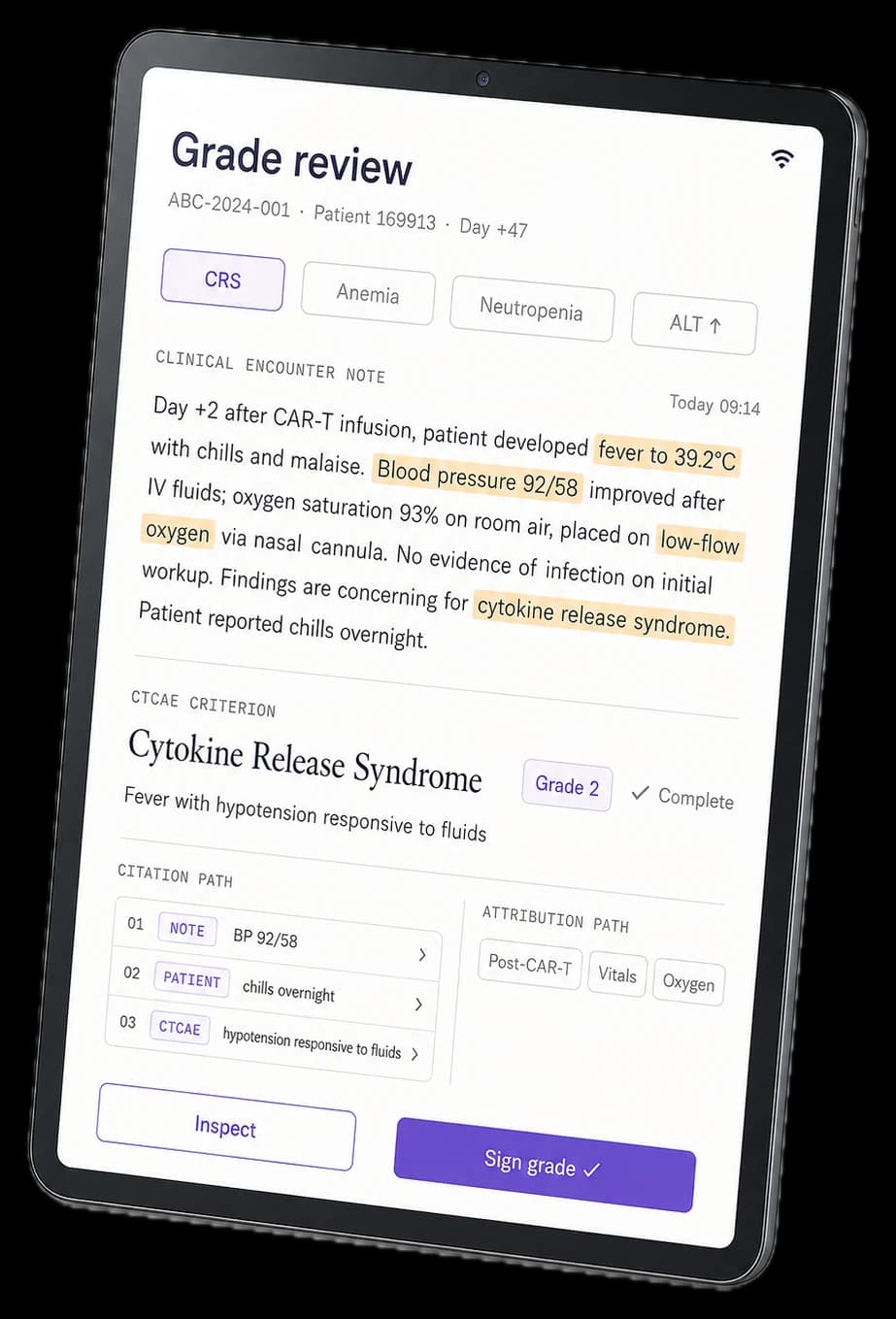
TODAY 09:14
Citation-bound CTCAE grading for oncology trials.
Twelve specialized agents in a patented cascading constraint pipeline grade every adverse event with the source sentence, the CTCAE criterion, the matching MedDRA LLT code, and the WHO-UMC or Kramer attribution path attached. Under three minutes per event. Monitor queries close on first read. Two patents filed.
837+ CTCAE criteria, v5.0 and v6.0. MedDRA v28.0 LLT codes on every graded event. 42 oncology regimen profiles. WHO-UMC and Kramer attribution. SMART on FHIR inside Epic, Oracle Health (Cerner), Athena, Allscripts, eClinicalWorks, MEDITECH, Dedalus, AGFA Orbis, and regional APAC systems. Human review on every signed record.
If the engine cannot cite it, it does not suggest it.
Per adverse event, with the source sentence, CTCAE criterion, and attribution path attached.
v5.0 and v6.0. The full ontology, structured for grading. 42 oncology regimen profiles backing the attribution.
Every grade requires a source sentence and a matching CTCAE criterion. Architectural constraint, not runtime filter. Two patents filed.
What CTCAE grading is, on Burna.
CTCAE grading is the standardized assignment of a severity grade (1 through 5) to an adverse event observed in an oncology trial or postmarket surveillance program. The grade is consequential. The reasoning behind the grade is the audit asset.
On Burna, every grade ships with three elements attached: the source sentence from the clinical note, the CTCAE criterion quoted verbatim, and the named-algorithm attribution path (WHO-UMC or Kramer) with per-drug probability scores when attribution is multi-drug. The engine cannot return a grade without these elements. The constraint is architectural. It is not a runtime filter, it is not a transparency layer added after the fact, it is a property of the cascade itself.
If the engine cannot cite it, it does not suggest it. No source sentence, no criterion, no grade. Every signed record carries a clinician's e-signature.
Cytokine Release Syndrome
Grade 2MedDRA · 10052015NEW
Fever with hypotension responsive to fluids
Low-flow oxygen support
VISIT TRAJECTORY
CITATION PATH
- 01NOTEBP 92/58 + low-flow O₂
- 02PATIENTPatient reported chills overnight · Care Journal
- 03CTCAEHypotension responsive to fluids
ATTRIBUTION PATH
Inside the EHR your unit already uses.
The product runs inside the EHR the unit already uses. The work is the work the coordinator, oncologist, or safety officer already does. Burna handles the lookup, the cross-reference, the attribution algorithm, and the audit assembly. The clinician keeps the judgment.
Read
Read the note
Burna reads the clinical note, the laboratory results, the medication list, the prior cycles, and the regimen protocol. It identifies candidate adverse events and cross-references every candidate against the 42 oncology regimen profiles and the 837+ CTCAE criteria. The work happens before the clinician opens the encounter.
Suggest
Suggest with evidence
Adverse events surface with a suggested grade, the source sentence highlighted in the note, the CTCAE criterion quoted verbatim, and the WHO-UMC or Kramer attribution path surfaced. Multi-drug attribution shows per-drug probability with the algorithmic reasoning visible. Confidence calibration flags cases that deserve extra clinician attention.
Sign
Review, modify, sign
The clinician reads the evidence. She agrees, modifies, or rejects. Modifications are logged with her reasoning. The signed record carries her e-signature, captured under a 21 CFR Part 11 trail. Every step is recorded for audit.
Flow
Flow to the system of record
Signed grades flow into the EDC (Medidata Rave, Veeva Vault EDC, Oracle Clinical One) for trial workflows, or into the ICSR pipeline for postmarket pharmacovigilance. Cross-site grading consistency surfaces while the trial is running.
AI suggests. Clinicians decide. Human-in-the-loop, always.
Ten capabilities. Every deployment.
The product is the citation-bound grading capability. The capabilities below ship with every deployment, in every audience configuration. Pricing scales with seat count, trial volume, and postmarket surveillance scope, not with capability gating.
The full CTCAE ontology and MedDRA LLT mapping
837+ CTCAE criteria across v5.0 and v6.0, each carrying its MedDRA v28.0 LLT code (see /meddra-coding for the coding capability in full). The same grading pass produces what the clinical trial database needs (CTCAE) and what pharmacovigilance and regulatory submissions need (MedDRA). An adverse event that does not have a defensible CTCAE criterion does not advance to a grade.
42 oncology regimen profiles
Cross-reference against active regimen, prior regimens, comorbid medications, and the 42 profile library. The pharmacological substrate is part of the grading decision, not a separate lookup the coordinator performs in another tab.
WHO-UMC and Kramer attribution, with per-drug probability
Multi-drug attribution is the oncology reality. Burna runs WHO-UMC (Certain, Probable, Possible, Unlikely, Unrelated, Conditional, Unassessable) and Kramer causality algorithms against the evidence record. Per-drug probability scores surface when attribution is multi-drug. The reasoning path is visible.
Citation, attached to every grade
The source sentence from the clinical note is highlighted. The CTCAE criterion is quoted verbatim. The attribution algorithm's reasoning path is surfaced. The evidence record travels with the grade end to end, into the EDC and into the audit trail.
21 CFR Part 11 e-signature trail
Every clinician signature is captured under a Part 11-aligned audit trail. Every modification is logged with the clinician's reasoning. Every rejection feeds back into site-specific tuning under explicit governance review.
SMART on FHIR inside the EHR the unit already runs
Epic, Oracle Health (Cerner), Athena, Allscripts, eClinicalWorks, MEDITECH, Dedalus (France, Italy, Spain), AGFA Orbis (Germany, Benelux), and regional APAC systems. If the EHR supports FHIR R4, Burna runs inside it. One OAuth client. One FHIR endpoint. No new login for the clinician.
EDC write-back to the systems the trial already uses
Signed grades flow into Medidata Rave, Veeva Vault EDC, and Oracle Clinical One. For postmarket programs, signed grades flow into the ICSR pipeline with E2B(R3) encoding for downstream regulatory submission. The integration is part of the product, not a separate professional services engagement.
Real-time across every site in the trial
Every grading decision propagates instantly across all stakeholders. Grade 3+ events trigger immediate alerts. In multi-site trials, cross-site grading inconsistency surfaces in real time, not at the next monitoring visit.
Seven to nine languages for clinical note interpretation
Clinical notes supported in English, French, German, Spanish, Portuguese, Italian, Japanese, Korean, and Arabic at launch. International sites are a first-class audience, not a localization roadmap item.
HIPAA, GDPR, and 21 CFR Part 11 aligned
Patient identifiers stay inside your network in on-premises deployments and inside your jurisdiction in regional cloud deployments. Regional residency at launch: US, EU, UK, Canada, Australia, Japan, Korea, Singapore, UAE, KSA. SOC 2 Type I attestation available now; SOC 2 Type II audit kicked off Q2 2026.
Four audiences. Same capability.
The product is built for the people who do oncology safety work every day, the people who buy the platform for them, and the people who audit the results. Each audience has a dedicated page for the deeper conversation.
Clinicians and Coordinators
In-EHRUnder three minutes per adverse event. The source sentence, CTCAE criterion, and attribution arrive with every suggestion. The clinician keeps the judgment. The audit trail is built before the monitor arrives.
Cancer Centers
90-day pilotCitation-bound grading inside Epic, Oracle Health, or the regional EHR. Real-time cross-site consistency. 90-day risk-reversed pilot with pre-registered workflow study endpoints and peer-reviewed co-authorship.
Pharma and Biotech
Protocol SafeAttribution decisions defensible at the point of clinical encounter. Protocol Safe deploys inside your tenant. The signal flows out; the protocol stays in. The same engine that powers the trial powers the postmarket PV program when the molecule reaches market.
CROs
White-labelCitation-bound grading across every site in the portfolio. Query economics compress structurally, not aspirationally. Monitor queries close on first read because the rationale is attached to the grade before the monitor opens the record.
The fact sheet.
The engine behind the product is a twelve-agent cascading constraint pipeline. The architecture deep-read lives at /engine.
Read the full architecture →Built on the same twelve-agent cascading constraint pipeline used everywhere on Burna.
What evidence to expect.
Burna does not publish accuracy percentages on this page. They will be published in peer-reviewed venues (target journals: JCO, JAMIA, JCO Clinical Cancer Informatics, Annals of Oncology). Until publication, kappa numbers and methodology are available under NDA to product evaluation conversations.
Read the validation brief →Prospective workflow study (in flight)
At a US cancer center, co-designed with Dr. Andrea Pirzkall (formerly CMO at Replimune and Asher Biotherapeutics; ED Clinical Development at BeiGene; Principal Medical Director at Genentech). Pre-registered endpoints including paired-grader timing, documentation completeness, and attribution agreement.
1,200-chart retrospective accuracy study
At a US NCI-designated comprehensive cancer center. Bio-IT World 2026 poster.
Second-site prospective workflow pilot
In an active GI oncology and Phase 1 trials program.
Postmarket pharmacovigilance pilot launching 2027
The same engine extended to the postmarket setting.
Two patents filed on the architecture. The pattern is the moat, not the implementation.
Twelve agents. Cascading constraints. Citation-forced output. The architecture deep-read lives on its own page.
The engine page covers each of the twelve agents, the cascade diagram, the four objections, and the patent posture. burna.ai/engine · 5-page Architecture and Implementation Brief available at security@burna.ai.
Three procurement paths. Same product.
Pricing scales with seat count, trial volume, and postmarket surveillance scope. Pilots are zero cost during the 2026 design partner cohort. Pricing detail is published on the audience page closest to the buyer's procurement context.
Cancer centers and academic medical centers
Tier 1 (mid-size AMCs, 30 to 80 active oncology trials): $200K to $500K annually. Tier 2 (major comprehensive cancer centers, 100+ active oncology trials): $500K to $1.5M annually. Regional pricing available for emerging markets.
Pharma and biotech sponsors
Protocol Safe pricing is per-program, scaled to trial portfolio and tenant configuration. Postmarket pharmacovigilance pricing is per-product. Per-trial $100K to $250K; portfolio ACV $2M to $5M.
CROs and site networks
Per-trial pricing with portfolio rate cards. 90-day paid pilots at $25K to $50K, scaled to trial size. White-label tier for site networks at $400K to $20M.
The ten we hear most often.
Product-specific questions. The full FAQ has the rest.
How is this different from a classifier or an LLM wrapper?
A classifier maps a note to a label. An LLM wrapper generates an output from a prompt and a retrieval step. Burna is neither. The engine is twelve agents in a cascading constraint pipeline; each agent's output bounds the input space of every downstream agent. Citation-bound output is a property of the architecture, not a property of the prompt. The engine structurally cannot produce a grade outside the defined CTCAE set, cannot skip citation, cannot contradict its own upstream findings. Architecture detail at /engine.
How much can we expect to reduce monitor queries by?
Across three Phase 1 oncology trials (Pronker et al., British Journal of Clinical Pharmacology, 2011), 85.7% of data clarification queries on adverse event forms were confirmation requests, not data corrections; 71.9% resulted in no change to the underlying data. The monitor was asking the site to confirm what the site already documented. Burna attaches the source sentence, the CTCAE criterion, and the named-algorithm attribution path at the moment of grading. The query the monitor would have asked is answered before it is opened. Pilots typically pre-register a target of 50% reduction in confirmation queries.
How long does integration actually take?
Two to three weeks from kickoff to first signed grade in the production environment. Your IT provisions one OAuth client and one FHIR endpoint. Burna's engineering team handles FHIR mapping, residency configuration, and EDC integration with Medidata Rave, Veeva Vault EDC, or Oracle Clinical One. The Implementation Lead is on-site for training and workflow walkthroughs.
Where does the patient data go?
Patient identifiers stay inside your network in on-premises deployments and inside your jurisdiction in regional cloud deployments. The grading model only sees de-identified clinical text. Regional residency at launch: US (AWS, Azure), EU (Frankfurt, Dublin, Paris), UK (London), Canada (Toronto), Australia (Sydney), Japan (Tokyo), Korea (Seoul), Singapore, UAE (Dubai), KSA (Riyadh).
Is this a medical device?
No. Burna is a clinical decision support tool. Clinicians approve every output. The platform does not prescribe, modify dose, or alter care pathways. 21 CFR Part 11, SOC 2, HIPAA, and GDPR aligned.
How does multi-drug attribution work?
WHO-UMC and Kramer causality algorithms run against the evidence record. When attribution is multi-drug, per-drug probability scores surface for each candidate exposure. The algorithmic reasoning path is visible. Central reviewers, sponsor monitors, and regulators see the named-algorithm justification, not a confidence number.
What does the e-signature workflow look like?
Every signed record carries a clinician e-signature under a 21 CFR Part 11-aligned audit trail. Modifications are logged with the clinician's reasoning. The audit packet for the monitor, the DSMB, and the regulator assembles as the work happens. The signature is captured on the encoded record (with MedDRA coding, CTCAE grade, and E2B(R3) encoding for downstream regulatory systems), not on the raw output.
Can Burna handle our regimen if it is not in the 42 profiles?
Yes. The 42 profiles cover the most common oncology regimens; the engine handles novel and combination regimens through pharmacological reasoning against the patient's active medication list and prior cycles. New regimen profiles are added under governance review as design partner cohorts surface them.
Will Burna train on our unit's notes?
Not without explicit opt-in and governance review. The default posture is no model training on customer data. When a unit opts in for site-specific tuning, the governance review documents what data flows where, how it is de-identified, and who approves the tuning cycle.
How is this different from Veeva, Argus, or downstream PV systems?
Veeva Vault Safety, Argus, ArisGlobal, and Medidata Detect operate downstream of the attribution decision. They manage cases after the investigator has decided what caused the adverse event. Burna operates upstream, where the investigator is making the attribution decision at the point of clinical encounter. The two are complementary.
Bring citation-bound grading into your next trial cohort.
The product runs inside the EHR your unit already uses. The integration is two to three weeks from kickoff to first signed grade. The pilot ships on the pilot outcome terms: pre-registered workflow study endpoints, peer-reviewed co-authorship, and if endpoints are not met the contract terminates with no further fee and the unit retains the deployment, the training materials, the playbook, and the manuscript.
Scoping through Q3 2026
The 2026 design partner cohort accepts pilot scoping conversations through the end of Q3 2026. Pilots that begin in Q4 2026 ship co-authored manuscripts in late 2027.
In success, your unit gets a citation-bound CTCAE workflow inside the EHR, the labor recovery the platform was scoped to produce, and a peer-reviewed manuscript with your unit as primary authors. If pre-registered endpoints are not met at study end, the contract terminates with no further fee, and your institution retains the deployment, the training materials, the change-management playbook, the Implementation Lead's work product, and the co-authored manuscript. Either way, your team publishes.
The quarterly safety briefing
Subscribe to the quarterly safety and data quality briefing. Validation readouts, platform updates, and conference timing only.
No tracking beacons, no marketing email cadence.